

Popular
Who is the main antagonist in Warlock and what are his motivations?
What role does the character of Clay Blaisedell play in the story?
How does the character of Johnny Gannon influence the events in Warlock?
What is the significance of the town of Warlock in the film?
How does the relationship between Clay Blaisedell and the townspeople evolve throughout the film?
Should I watch it?
Ask Your Own Question

What is the plot?
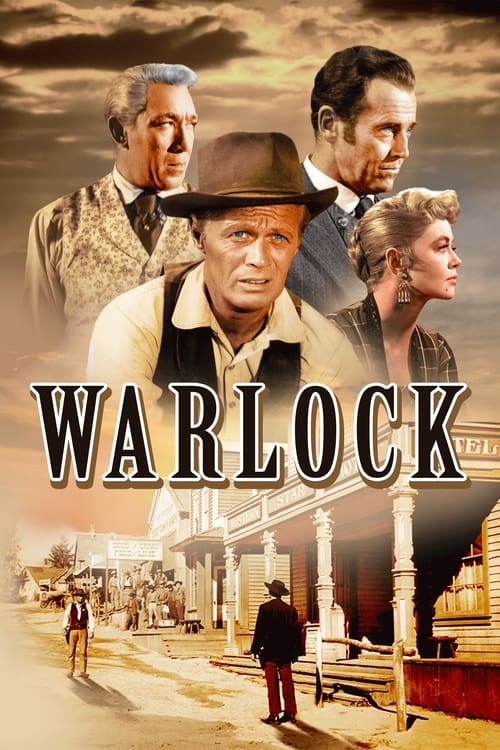
In the dusty frontier mining town of Warlock, Utah, a reign of terror grips the streets as a gang of renegade cowboys led by the ruthless Abe McQuown unleashes chaos. Gunshots echo through the night, saloons shatter under hails of bullets, and the local sheriff cowers in humiliation, driven out of town by McQuown's men. Desperate citizens, their faces etched with fear and resolve, convene in a tense town meeting. "We need someone who can handle this," one miner declares, his voice trembling. They pool their money and send for a legend: Clay Blaisedell, the infamous gunman and gambler known for his implacable methods and gold-handled revolvers that gleam like promises of death.
Clay arrives on horseback under a blazing sun, his tall frame cutting an imposing silhouette against the horizon, accompanied by his club-footed shadow, Tom Morgan, a man whose twisted devotion to Clay borders on obsession. Morgan limps loyally at his side, eyes burning with a fanatic gleam, having sublimated all his ambitions into worshiping the man he calls his savior. The townsfolk cheer tentatively as Clay surveys the ramshackle boardwalks and fearful faces, his steel-blue eyes unreadable. Without legal badge or warrant, the town council grants him free rein--a paladin to clean up their mess. Clay wastes no time, establishing his gambling house and saloon, where cards flick and whiskey flows, drawing the town's pulse under his control.
Among the locals, Johnny Gannon watches from the shadows. A rugged member of McQuown's gang, Johnny wrestles with inner turmoil, his loyalty fraying as the violence sickens him. His brother, Billy Gannon, rides fiercely with the cowboys, as does the mischievous Curley Burne, whose easy grin hides a killer's heart. In town, Jessie Marlow, a poised singer with a gentle spirit and eyes full of quiet longing, performs in Clay's saloon, her voice weaving melancholy melodies that hint at her growing affection for the gunman. Tension simmers as Clay's presence emboldens the timid residents, but McQuown's riders continue their rampage, testing the new enforcer.
Word spreads of a stagecoach approaching from the desert route, carrying passengers bound for Warlock. Tom Morgan intercepts the news with a predatory glint: his old flame, Lily Dollar, a fiery saloon girl with a scarred past, travels with Bob Nicholson, brother of Big Ben Nicholson--a man Clay killed in a prior town. Morgan's history unravels in flashes of bitterness: he once pimped Lily out for cash when desperation struck, driving her into Big Ben's arms. Worse, Morgan manipulated Big Ben into challenging Clay, ensuring his friend's victory and his own twisted validation. Now, Lily burns with vengeance, knowing Morgan's hand in Ben's death; she craves Clay's end to punish her betrayer.
Morgan rides out alone to meet the stage, his limp no hindrance to malice. From a rocky ridge, he spots McQuown's men--Billy Gannon among them--ambushing the coach in a whirlwind of dust and gunfire. Passengers spill out, terrified. As Bob Nicholson stumbles from the wreckage, exposed and vulnerable, Morgan seizes the chaos. His rifle cracks from afar, unseen by all, and a bullet tears through Nicholson's chest. Bob crumples dead in the dirt, blood staining the sand, the first casualty in Morgan's web of deceit. The robbers scatter with their loot, oblivious to the extra corpse.
Clay assembles a posse and rides to the scene, his gold-handled guns holstered low. They round up the three robbers--Billy Gannon and two others--without resistance, the air thick with the metallic tang of blood and gunpowder. Back in Warlock, a mob bays for the prisoners' blood, but Clay holds them at bay, his voice a calm thunder: "Justice, not vengeance." The sheriff, disapproving of this freelance marshal, eyes Johnny Gannon's conflicted stance. Johnny steps forward, hand raised. "Let me be your deputy," he offers, breaking from the gang in a surge of moral awakening. "I'll see this through right." The sheriff accepts, swearing Johnny in as Warlock's resident deputy, his badge glinting like a fragile promise amid the town's divided loyalties.
Lily arrives amid the turmoil, stepping from the stagecoach wreckage with fire in her eyes. Spotting Morgan in the crowd, her face twists in recognition and rage. "You pulled the trigger on Bob, didn't you?" she hisses, her voice slicing through the murmurs. Morgan's smile falters, but he denies it smoothly, his club foot dragging as he retreats. Later, in a shadowed alley behind the saloon, he corners her, desperation cracking his facade. "Come back to me, Lily. We were good once." She spits back, eyes blazing: "You pimped me out when you needed money, Tom. You're poison." Her rejection fuels his unraveling psyche, the emotional wound festering beneath his devotion to Clay.
Emboldened, McQuown's remaining cowboys--Billy Gannon, Curley Burne, and others--ride into Warlock seeking revenge for their captured kin and to crush Clay's grip. Signs sprout on lampposts, scrawled by Curley: "We are the Regulators. We have the right to kill Clay Blaisedell." The town fractures, some cheering the cowboys' audacity, others rallying to Clay. Billy Gannon and his two vengeful comrades storm the main street at high noon, guns blazing. "This town's ours!" Billy shouts, his face a mask of fury.
Chaos erupts in a thunderous gun battle. Clay strides into the fray, his revolvers barking death. He guns down one of Billy's companions in a flash of muzzle fire, the man spinning into the dust with a gurgling cry--first cowboy death by Clay Blaisedell. Bullets whine past storefronts as townsfolk cower. Billy draws on Clay, but Johnny intervenes desperately: "Billy, no! Don't do this!" His plea ignored, Billy fires wildly. Clay's second shot drops the other companion, body slumping against a hitching post--second cowboy death by Clay Blaisedell. Billy charges, but a stray round from the melee clips him; he falls mortally wounded, gasping his brother's name before expiring--Billy Gannon killed in the crossfire. Johnny cradles his brother's body, tears streaking his dust-caked face, the emotional fracture deepening his resolve for law over outlawry.
The battle leaves some townsfolk turning against Clay's brutal vigilantism, whispers of "too much blood" rippling through the saloons. Jessie sings a haunting ballad that night in Clay's establishment, her hand lingering on his arm, eyes pleading for the man beneath the gunman. "Stay, Clay. You could build something here," she murmurs later in a candlelit room, her fingers tracing his jaw. But Clay's gaze drifts to the window, haunted by cycles he can't escape.
Morgan seethes in the shadows, his devotion cracking as Johnny's star rises. The regulators regroup under Abe McQuown, posting more defiant signs, declaring themselves the true law. They ride into Warlock again, this time to confront Johnny for his betrayal. Hooves pound the street as McQuown's gang--now leaner, meaner--faces down the deputy at dusk, shadows lengthening like omens. Johnny stands alone in the jailhouse door, hand bandaged from an earlier scrape, heart pounding. "This ends now, Abe. You're done terrorizing this town."
Clay volunteers to back him, striding forward with predatory grace. But Morgan erupts, pulling a gun on his idol. "Stay out of it, Clay! This is Gannon's fight." His voice cracks with jealousy, eyes wild. Clay freezes, betrayed shock flickering across his chiseled features. Johnny faces the gang solo, tension coiling like a spring. McQuown sneers, "You're one of us, Gannon. Traitor gets what's coming." Guns draw in a heartbeat.
Gunfire shatters the evening calm. Johnny's shots ring true despite his injured hand, but Curley Burne hesitates, yelling, "A fair fight, Johnny!" He blocks a back-shooter from the gang, turning the tide. Citizens, inspired by Johnny's stand, grab rifles from windows, peppering the cowboys. McQuown charges, his face a snarl of rage, but Johnny's bullet rips through his chest. Abe staggers, eyes widening in disbelief, and collapses in the dirt--Abe McQuown killed by Johnny Gannon. The regulators shatter, fleeing or falling; the gang breaks for good amid cheers and smoke.
Triumph sours for Morgan. Johnny emerges the hero, townsfolk slapping his back, Lily's gaze lingering on him with newfound warmth. Morgan drowns his rage in whiskey at Clay's saloon, smashing bottles, his limp exaggerated in drunken fury. "Gannon? That weakling? You're the hero, Clay! Not him!" In a slurred confrontation, truths explode. Lily confronts Morgan publicly, her voice venomous: "You killed Big Ben by pushing him at Clay, then murdered Bob to hide it!" Clay overhears, piecing it together--the manipulations, the stagecoach sniper, Lily's past exploitation. His face hardens like granite. "You used me, Tom. All of it." He turns his back, the ultimate rejection slicing Morgan's soul.
That night, blackout drunk and unhinged, Morgan staggers to the jail, pounding on bars. "Gannon! Face me!" Johnny rises, but Clay intervenes, locking the deputy in his own cell with grim finality. "Tom Morgan's my responsibility." Morgan slinks away, momentarily placated, a twisted smile on his lips as the town hails Clay once more. But dawn breaks with jeers: townsfolk mock the club-footed cripple from porches. "Run home, limpy!" Pride shatters. Morgan whirls, gun drawn. "Blaisedell! Now!"
The street empties in the pale morning light, tension electric. Clay faces his former devotee, gold-handled revolvers loose in holsters. Morgan's eyes blaze mania. "I made you, Clay!" They circle, dust devils swirling. Morgan draws first, his shot grazing true--Clay's hat spins off his head, tumbling in the dirt. A split-second later, Clay's revolver thunders. Morgan jerks, blood blooming on his chest, crumpling to his knees. With a rapturous gasp, he whispers, "I won, Clay, I won!" before collapsing dead, eyes frozen in delusional victory--Tom Morgan killed by Clay Blaisedell.
The town mourns briefly, but eyes turn to the new rift. Jessie bursts from the saloon, clutching Clay's arm in the aftermath, tears streaming. "Stay, Clay. Be a farmer, a store clerk--anything but this!" Her voice breaks, love raw and pleading. Lily, now entwined romantically with Johnny, rushes to them, her vengeance spent. "Don't make him kill you, Clay. For all of us." Johnny, released from jail, stands resolute, badge heavy on his chest.
Morning sun crests as Clay and Johnny meet in the wide main street, dust motes dancing like specters. Clay straps on his gold-handled revolvers, symbols of his endless path. They face off, hands hovering. Johnny draws--swift, determined--but Clay outdraws him effortlessly, guns blazing. Yet each time, Clay hurls his weapon into the dirt, sparks flying. Again, Johnny draws; again, Clay wins but discards the gun. A third time seals it. The town watches, breathless. Clay holsters empty, mounts his horse. "Another town, another Morgan," he mutters, riding into the shimmering horizon, leaving Warlock to Johnny's law.
Johnny and Lily embrace amid cheers, Jessie watching forlornly from the boardwalk. The cycle breaks here, but Clay's shadow lingers--a gunman doomed to wander, cleaning messes too big for the law, forever chasing devils of his own making.



What is the ending?
In the ending of the movie "Warlock," the town of Warlock faces a climactic showdown between the characters. The gunman, Clay Blaisedell, confronts the warlock, who has been manipulating events for his own gain. In a final confrontation, Blaisedell kills the warlock, but not without significant personal cost. The town is left to grapple with the aftermath of the violence, and Blaisedell, having lost his purpose, decides to leave Warlock behind.
As the sun begins to set over the dusty town of Warlock, the atmosphere is thick with tension. The townspeople, who have been caught in the crossfire of the conflict between the warlock and the gunman, are on edge, their faces reflecting a mix of fear and anticipation. Clay Blaisedell, the gunman, stands resolute, his eyes scanning the horizon for the warlock, who has been a source of chaos and manipulation.
In the heart of the town, the warlock, played with a sinister charm, prepares for the final confrontation. He has been a puppet master, pulling the strings of the townsfolk and instigating violence to serve his own dark purposes. As Blaisedell approaches, the warlock taunts him, confident in his own power. The tension escalates as the two men face off, each representing opposing forces: Blaisedell, the embodiment of justice and retribution, and the warlock, a figure of malevolence and control.
The showdown is intense. Blaisedell, fueled by a mix of anger and determination, draws his gun. The warlock, with a smirk, attempts to use his dark magic to sway the outcome. However, Blaisedell's resolve is unyielding. In a swift and decisive moment, he fires his weapon, and the bullet finds its mark. The warlock falls, his power extinguished, leaving behind a silence that envelops the town.
As the dust settles, the townspeople emerge from their hiding places, witnessing the aftermath of the confrontation. There is a palpable sense of relief, but it is tinged with sorrow. Blaisedell, having fulfilled his mission, feels the weight of his actions. He looks around at the town he has fought to protect, but he also sees the destruction and loss that has accompanied his fight. The emotional toll is evident on his face; he has become a reluctant hero, burdened by the violence he has had to unleash.
In the final moments, Blaisedell makes the difficult decision to leave Warlock. He understands that his presence may only bring more conflict and that the town must find its own way to heal. As he rides away, the townspeople watch him go, their expressions a mix of gratitude and sadness. They have been liberated from the warlock's grip, but the scars of the battle will linger.
The fate of the main characters is sealed in this moment. Blaisedell rides off into the sunset, a solitary figure marked by the choices he has made. The warlock lies defeated, his reign of terror ended, but the cost of that victory weighs heavily on the town. The final scene captures the essence of the struggle: the fight between good and evil, the personal sacrifices made in the name of justice, and the enduring impact of violence on a community. The screen fades to black, leaving the audience to ponder the complexities of heroism and the consequences of conflict.
Is there a post-credit scene?
The movie "Warlock," produced in 1959, does not have a post-credit scene. The film concludes with a definitive ending that wraps up the story without any additional scenes after the credits. The narrative focuses on the conflict between the townspeople of Warlock and the gunman, as well as the moral dilemmas faced by the characters, particularly the town's sheriff and the enigmatic figure of the warlock himself. The film ends on a note that emphasizes the themes of justice and redemption, leaving no room for a continuation or additional scenes after the main story concludes.
Who is the main antagonist in Warlock and what are his motivations?
The main antagonist in Warlock is a character named 'The Warlock,' played by actor Richard Widmark. His motivations are rooted in a desire for power and control over the town of Warlock, as he seeks to establish himself as a formidable force by instilling fear and chaos among the townspeople. He uses his cunning and ruthless tactics to manipulate others to achieve his goals.
What role does the character of Clay Blaisedell play in the story?
Clay Blaisedell, portrayed by Henry Fonda, is a gunfighter who arrives in the town of Warlock to help restore order. His internal conflict revolves around his past as a hired gun and his desire to protect the innocent townsfolk from the Warlock's tyranny. Blaisedell's motivations are driven by a sense of justice and a longing for redemption, as he grapples with the consequences of his violent lifestyle.
How does the character of Johnny Gannon influence the events in Warlock?
Johnny Gannon, played by Anthony Quinn, is a former outlaw who becomes an ally to Clay Blaisedell. His influence is significant as he represents a more complex moral perspective, often torn between his past and the desire to do right. Gannon's character adds depth to the narrative, as he struggles with loyalty and the implications of violence, ultimately impacting the dynamics between Blaisedell and the Warlock.
What is the significance of the town of Warlock in the film?
The town of Warlock serves as a microcosm of lawlessness and the struggle for order. It is a place where the characters' motivations and conflicts unfold, highlighting the themes of power, fear, and redemption. The town's fate is directly tied to the actions of the Warlock and the gunfighters, making it a pivotal setting that shapes the narrative and character arcs.
How does the relationship between Clay Blaisedell and the townspeople evolve throughout the film?
Initially, the townspeople are wary of Clay Blaisedell due to his reputation as a gunfighter. However, as he takes a stand against the Warlock, their perception of him shifts from fear to respect. Blaisedell's willingness to protect them and confront the Warlock fosters a sense of trust and camaraderie, ultimately leading to a united front against the antagonist. This evolution reflects Blaisedell's journey towards redemption and acceptance within the community.
Is this family friendly?
The movie "Warlock," produced in 1959, contains several elements that may not be considered family-friendly or suitable for children and sensitive viewers. Here are some potentially objectionable aspects:
-
Violence: The film features gunfights and confrontations that result in injury and death. The portrayal of violence is somewhat graphic for the time, with scenes of characters being shot or attacked.
-
Themes of Revenge and Morality: The narrative explores darker themes such as revenge, moral ambiguity, and the consequences of one's actions, which may be unsettling for younger audiences.
-
Supernatural Elements: The presence of a warlock and the use of witchcraft may be disturbing to some viewers, particularly those sensitive to themes involving the occult.
-
Character Conflicts: The emotional turmoil and conflicts between characters can be intense, showcasing jealousy, betrayal, and desperation, which might be distressing for some.
-
Death and Loss: The film addresses themes of mortality and loss, with characters facing dire situations that could evoke strong emotional responses.
These elements contribute to a tone that may not be suitable for all viewers, particularly children or those who are sensitive to violence and darker themes.








