









Popular
How does Nobita's character develop throughout the movie?
Who is Peko and what role does he play in the story?
What challenges do Nobita and his friends face during their exploration?
What is the significance of the exploration party of five?
What is the main conflict involving the demon world in the movie?
Should I watch it?
Ask Your Own Question

What is the plot?
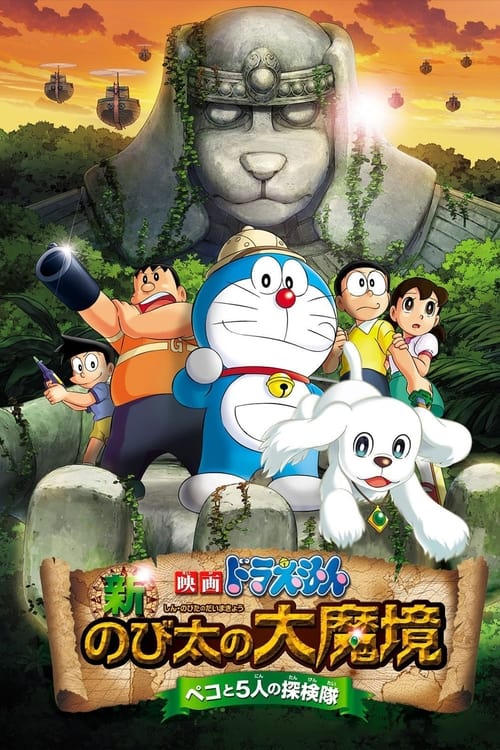
Gian, Nobita Nobi, and Suneo first sit around in the heat of summer vacation talking about going on an adventure, but none of them can decide where to go, so they dump the responsibility onto Nobita. Nobita turns to Doraemon, and Doraemon comes up with a wild search plan: he launches a rocket from the roof of Nobita's house to take aerial photographs of the Earth, hoping they can spot somewhere undiscovered. Before that larger journey even begins, the film gives the story an eerie undertone: Gian sees a spirit-like figure that tells him to accomplish a task, while elsewhere stray dogs root through garbage in the rain and a dirty white dog appears as if out of nowhere, staring them down and chasing them off. That strange opening hangs in the air like a prophecy, hinting that the dog story and the adventure story are really the same story waiting to collide.
At home, Nobita is sent out on a mundane errand by Tamako Nobi to buy groceries, and on the way he passes a playground where he notices an abandoned dog all alone. Feeling sorry for it, he buys sausages and feeds it, and the dog immediately proves itself clever and unusually responsive, even helping with a missing-purse situation by tracking the scent from Tamako's slipper. Nobita is allowed to keep the dog, and he names him Peko. At this point Peko seems like nothing more than a loyal stray, but the film keeps slipping in odd details that make him feel bigger than he first appears: he reacts intensely to certain images, seems to know things he should not, and carries himself with a strangely noble, almost human dignity.
Nobita brings Peko home, and he, Doraemon, and the others continue searching for a place worthy of a real summer expedition. Doraemon's satellite-photo idea produces an overwhelming number of images, but among the endless data they eventually find what looks like proof of an undiscovered land: a mysterious statue shrouded in fog somewhere in Africa. The image electrifies the group, because they believe they have found something nobody else in the world has seen. Nobita, Doraemon, Shizuka Minamoto, Gian, and Suneo all join the expedition, with Peko tagging along as the group's newest, quietest member. The tone shifts from ordinary summer boredom to a genuine adventure, and the journey begins in bright anticipation, with the children imagining a grand discovery instead of the danger waiting beneath the green jungle canopy.
The first days in Africa are all motion, heat, and excitement. The group pushes through forest and savannah, laughing one moment and shouting the next as the wilderness immediately starts testing them. They encounter wild animals, including alligators, and each scare makes the adventure feel more real and less like a game. Doraemon repeatedly saves the day with gadgets, but the convenience quickly turns into a source of frustration. Gian, who wants the expedition to feel like a proper challenge rather than a parade of miraculous tools, becomes increasingly irritated when the group depends too much on Doraemon's inventions. His breaking point comes when Shizuka uses the Anywhere Door simply to go home to use the restroom, and Gian erupts in anger, accusing everyone of treating the journey like a joke and angrily calling off the adventure. The scene is funny on the surface, but it also creates a real fracture in the group: Gian's outburst exposes how fragile their teamwork is once the thrill of discovery starts to feel inconvenient.
Even after that argument, the expedition continues, because the mystery is no longer just about finding a place on a map. The statue keeps appearing in their path like a beckoning landmark, and eventually the group reaches a deep gorge and the surrounding underground river area. There, at the lowest point of the journey, the story finally opens its hidden center. Peko, who has been growing more trusting by the minute, reveals that he is not just a dog at all: he is a prince from a kingdom of bipedal dogs with human intelligence. The revelation transforms the entire film in a single breath. The "stray dog" Nobita brought home is a royal exile from an advanced civilization hidden in Africa's Smokers Forest, a world where dogs evolved into a separate empire.
Peko explains the truth in a voice that carries both shame and urgency. His kingdom is being seized from within by the evil minister Daburanda, who is working with his scientist ally Dr. Kos to expand power and, ultimately, conquer the world. The deeper betrayal is personal: Daburanda has already murdered the king. In the coup's chaos, Peko is trapped inside a coffin and accidentally thrown into the underground river in the gorge, which is how he drifts away from the kingdom and ends up in Nobita's world. That moment is the film's major emotional pivot, because it redefines every earlier image of Peko as an orphaned, hunted survivor rather than an ordinary lost pet. Nobita and the others understand at once that the adventure is no longer about a hidden statue or a cool discovery; it is about helping a rightful prince reclaim his homeland and stop a hostile regime before it spreads beyond the forest.
From there, the expedition becomes a rescue mission. Doraemon, Nobita, Shizuka, Gian, Suneo, and Peko push deeper into the hidden country, where the dog kingdom's scientific sophistication becomes unmistakable. The kingdom is full of advanced machinery and a civilization built on the intelligence of its dog citizens, but its people are living under oppression. The oppressive presence of Daburanda hangs over everything, and the closer the heroes get to the center of power, the more the film tightens around its confrontation structure. The mysterious statue they discovered earlier is not just a monument; it is a giant machine with a hidden heart mechanism that can bring the statue alive like a robot. That object becomes the key to the final battle, because it gives the heroes a way to fight back against Daburanda's forces on equal terms.
As the conflict escalates, the story keeps returning to the contrast between noble purpose and brute power. Peko's mission is to save his kingdom and the fiancée waiting there for him, Princess Spiana or Princess Piana depending on the translation, while Daburanda's side relies on soldiers, weapons, and Dr. Kos's destructive planning. The heroes struggle through the kingdom's defenses, and every step forward is hard-won. The statue's mechanism becomes active only after the group reaches its heart, and once they do, they use that activation to tip the balance of power. The giant statue comes alive like a robot, and its movement is both awe-inspiring and terrifying, a visual confirmation that the forgotten mystery they found in a photograph is actually a weapon of liberation. Dr. Kos's army is defeated through this mechanism, ending his military advantage and clearing the way for the final confrontation with Daburanda himself.
Daburanda does not surrender. Instead, he flees to the palace and tries to escape with Princess Spiana/Piana, using her as his last bargaining chip and final symbol of legitimacy. This is the climax's sharpest personal conflict: the usurper is no longer merely defending his regime, but running for his life while attempting to drag the kingdom's future with him. At the moment when it feels as if he might get away, Peko arrives using the statue, cutting him off and rescuing the princess before Daburanda can vanish into safety. The confrontation ends with Daburanda's authority shattered. The film does not describe a complicated trial or negotiation; it resolves the moral line cleanly. Daburanda is exposed as the murderer and traitor he is, Dr. Kos's forces are beaten, and Peko's rightful claim to the throne is restored.
Along the way, the film's deaths are limited but significant, and each one matters to the plot. The only explicit killing identified in the plot materials is the assassination of the dog kingdom's king by Daburanda. That death is the original crime that destabilizes the kingdom and sends Peko into exile, which means the entire adventure is built on the consequences of that murder. Peko himself is not killed; he is sealed in a coffin and cast into the underground river, surviving by chance and fate until Nobita finds him. No other character deaths are identified in the available plot information, and the story's tension comes from capture, chase, and political overthrow rather than a body count.
The emotional weight of the ending comes from how completely Peko's identity is restored. He began as a stray dog in the rain, then became Nobita's pet, then transformed into a prince, and finally returns to the role he was born to fill. The heroes' support is crucial, but the film frames the victory as Peko's rightful return rather than an outside rescue that erases him. Once Daburanda is driven off and the palace is secured, Peko is recognized as the legitimate ruler of the kingdom again. The hidden dog empire is no longer an absurd legend or a scientific curiosity; it is a living society with its future returned to its proper hands. The ending also provides a quiet, almost playful coda in which the original Doraemon gives the alternate Doraemon a new Anywhere Door so he can go home, a small gesture that closes the loop on the gadget chaos that had annoyed Gian earlier. That final detail softens the scale of the adventure, bringing the fantastical journey back down to a warm, familiar Doraemon ending: the world is wider and stranger than before, but friendship and small acts of help still matter most.
In the last stretch, the story settles into relief rather than spectacle. The kingdom is saved, the usurper is gone, the princess is rescued, and Peko is no longer drifting between worlds as a lost animal but standing where he belongs as the rightful ruler. Nobita, who began the summer wanting only a fun adventure, ends up having participated in the liberation of an entire civilization, and his kindness toward a hungry dog in the rain becomes the first necessary step in undoing a coup and restoring a throne. The film closes with the sense that what looked like a simple pet story was always a royal epic waiting to unfold, and the last emotional impression is one of homecoming: Peko has found his kingdom, the kingdom has found its prince, and the summer adventure has become something far larger than anyone expected.
More Movies Like This
Browse All Movies →



What is the ending?
In the ending of "Doraemon: New Nobita's Great Demon - Peko and the Exploration Party of Five," Nobita and his friends successfully defeat the demon king, saving Peko and restoring peace. They return to their world, and Nobita learns the importance of friendship and courage.
As the climax of the film approaches, the scene unfolds in the demon king's lair, a dark and foreboding place filled with ominous shadows and flickering lights. Nobita, Shizuka, Gian, and Suneo stand together, their faces a mix of determination and fear. Peko, the loyal dog spirit, is captured, and the group feels the weight of their mission pressing down on them. Nobita, feeling the responsibility of his friends and Peko, rallies them with a heartfelt speech about the power of friendship and the need to fight for what they believe in.
The battle begins, and the demon king, a towering figure with a menacing presence, unleashes his dark magic. The friends work together, using their unique abilities and the gadgets provided by Doraemon. Shizuka's intelligence shines as she devises a plan to distract the demon king, while Gian and Suneo provide the muscle needed to confront the enemy. Nobita, despite his initial hesitations, finds his courage and steps forward, wielding a special artifact that Peko had entrusted to him.
As the fight intensifies, the emotional stakes rise. Peko, witnessing his friends' bravery, draws strength from their determination. The scene is filled with vibrant colors and dynamic action, showcasing the clash between light and darkness. Nobita's resolve strengthens, and he channels his feelings for Peko and his friends into a powerful attack that ultimately weakens the demon king.
In a final showdown, Nobita and his friends combine their strengths, launching a coordinated effort that culminates in a brilliant display of light. The demon king is defeated, and with his defeat, Peko is freed from his curse. The atmosphere shifts from one of despair to joy, as the friends embrace Peko, who is now restored to his true form.
As they return to their world, the landscape shifts from the dark, oppressive environment of the demon realm to the familiar, warm surroundings of their home. The friends share a moment of reflection, realizing how much they have grown through their adventure. Nobita, in particular, feels a deep sense of gratitude for his friends and the bond they share.
In the final scenes, the group is seen playing together, laughter echoing in the air. Nobita, now more confident and self-assured, understands the value of friendship and the importance of standing up for what is right. Peko, now a part of their lives, symbolizes the enduring spirit of loyalty and courage. The film closes with a sense of hope and unity, leaving the audience with a heartwarming message about the strength found in friendship and the adventures that await them in the future.
Is there a post-credit scene?
In "Doraemon: New Nobita's Great Demon - Peko and the Exploration Party of Five," there is indeed a post-credit scene. After the main story concludes, the scene shifts to a light-hearted moment featuring Nobita and his friends. They are seen enjoying a peaceful day at school, reflecting on their recent adventure.
In this scene, Nobita is animatedly recounting their thrilling experiences with Peko and the exploration party, emphasizing the bonds they formed and the lessons they learned about friendship and courage. His friends, Shizuka, Gian, and Suneo, listen with a mix of amusement and admiration, occasionally teasing Nobita about his tendency to exaggerate.
As the camera pans out, we see Doraemon, who has been quietly observing the group, smiling fondly at Nobita's enthusiasm. The scene captures a warm, nostalgic feeling, reminding viewers of the importance of friendship and the adventures that lie ahead. The film ends on a light note, leaving the audience with a sense of joy and anticipation for future escapades.
How does Nobita's character develop throughout the movie?
Nobita's character undergoes significant development throughout the movie. Initially portrayed as timid and unsure of himself, he gradually learns to take responsibility and show leadership qualities. His determination to protect Peko and his friends drives him to confront his fears, ultimately leading to a more confident and courageous version of himself by the end of the story.
Who is Peko and what role does he play in the story?
Peko is a key character in 'Doraemon: New Nobita's Great Demon - Peko and the Exploration Party of Five.' He is a small, dog-like demon who becomes Nobita's companion. Peko is not only adorable but also possesses unique abilities that aid the group during their adventures. His loyalty and bravery are central to the plot, as he helps Nobita and his friends navigate the challenges they face.
What challenges do Nobita and his friends face during their exploration?
During their exploration, Nobita and his friends encounter various challenges, including treacherous terrains, hostile creatures, and puzzles that test their teamwork and problem-solving skills. They must work together to overcome these obstacles, which often leads to moments of tension and growth among the characters.
What is the significance of the exploration party of five?
The exploration party of five, consisting of Nobita, Shizuka, Suneo, Gian, and Peko, symbolizes friendship and teamwork. Each character brings unique strengths to the group, and their interactions highlight the importance of collaboration. The dynamics within the group evolve as they face challenges together, reinforcing their bonds and showcasing their individual growth.
What is the main conflict involving the demon world in the movie?
The main conflict involving the demon world arises when Nobita and his friends inadvertently become entangled in a struggle between Peko's world and a malevolent force threatening it. This conflict drives the narrative, as the group must navigate the complexities of the demon world, confront adversaries, and ultimately find a way to restore peace, all while learning valuable lessons about courage and friendship.
Is this family friendly?
"Doraemon: New Nobita's Great Demon - Peko and the Exploration Party of Five" is generally considered family-friendly, as it is part of the beloved Doraemon franchise aimed at children. However, there are a few scenes and themes that might be potentially objectionable or upsetting for some children or sensitive viewers:
-
Conflict and Tension: The film features moments of conflict between characters, which may include arguments or misunderstandings that could be distressing for younger viewers.
-
Emotional Struggles: Characters experience feelings of fear, sadness, and loneliness, particularly in relation to their adventures and the challenges they face. These emotional moments may resonate deeply and could be upsetting for sensitive children.
-
Dangerous Situations: The characters find themselves in perilous situations during their exploration, which may involve threats from antagonistic forces or creatures. While these are presented in a fantastical context, they could still evoke anxiety.
-
Loss and Sacrifice: Themes of loss and the importance of friendship and sacrifice are explored, which may lead to emotional scenes that could be heavy for some viewers.
-
Mild Scary Elements: There are fantastical creatures and scenarios that might be perceived as scary, particularly for younger children who may be sensitive to such imagery.
Overall, while the film is designed to be entertaining and suitable for children, parents may want to consider these elements when deciding if it is appropriate for their children.








