
















Popular
What is the significance of Jack's heart and how does it affect his life?
How does Jack's relationship with Miss Acacia develop throughout the film?
What role does the character of Georges Meliès play in Jack's journey?
What challenges does Jack face in his quest to find Miss Acacia?
How does the setting of the film influence the story and characters?
Should I watch it?
Ask Your Own Question

What is the plot?
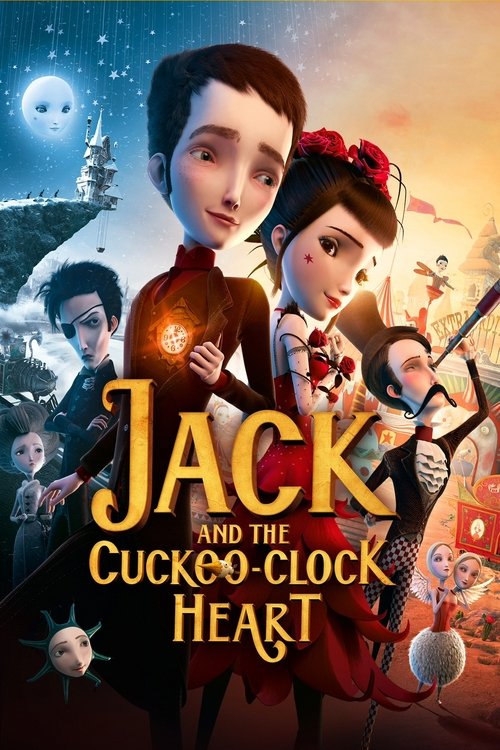
In the frozen grip of Edinburgh, Scotland, on the coldest day in 1874--a winter storm so brutal that birds plummet from the sky like stones and teardrops crystallize into ice pearls--a newborn boy named Jack enters the world with a heart of solid ice, refusing to beat. High on a windswept cliffside, in the cluttered workshop of Docteur Madeleine, a childless midwife and ingenious inventor voiced with gravelly warmth, she delivers him amid howling gales battering the windows. Jack's unnamed birth mother, her face etched with exhaustion and regret, cradles the infant briefly before pressing him into Madeleine's arms. "You'll be a better mother than I ever could," she whispers, her voice cracking like thin ice, before vanishing into the storm-swept night, abandoning her son forever. Madeleine, her eyes gleaming with fierce maternal resolve, sees no choice but to save the child she now claims as her own. With deft hands amid gears and clockworks scattered across her table, she surgically extracts the frozen heart and replaces it with a delicate cuckoo clock mechanism, its intricate brass ticking faintly to life. The operation succeeds, but Madeleine knows the fragility of her creation. As Jack grows into a pale, wide-eyed boy under her protective gaze, she instills in him three golden rules to preserve his mechanical life: "Never touch the hands of your clock heart, never lose your temper, and never, ever fall in love."
Years pass in the sheltered sanctuary of Madeleine's cliffside home, a labyrinth of whirring automatons, half-assembled timepieces, and flickering lanterns that cast long shadows over Jack's isolated childhood. Sheltered from the world's cruelties, Jack learns to wind his heart with a tiny key, feeling its rhythmic pulse against his chest like a bird trapped in a cage. Madeleine watches him with a mix of pride and worry, her inventions clanking softly in the background--gears turning, pendulums swinging--as she teaches him caution above all. But curiosity stirs within Jack, a restlessness that quickens his clock's tempo. On his tenth birthday, he begs for his first venture into Edinburgh town below. Madeleine relents, her face lined with reluctance, wrapping him in layers against the chill. "Stay calm, my boy," she murmurs, pressing the winding key into his palm. "Remember the rules."
Descending the snowy paths into the bustling streets of Edinburgh, Jack's senses awaken to the clamor of horse-drawn carts, vendors hawking frost-kissed wares, and children laughing in woolen scarves. The air hums with distant music, drawing him like a moth to flame. He wanders toward a barrel organ grinding a haunting melody, its pipes exhaling steam in the cold. There, cranking the handle with nearsighted focus, stands a girl of ethereal beauty: Miss Acacia, her dark hair framing a face alive with melody, her fingers dancing over the keys. As the organ's notes swell--a flamenco-tinged waltz that pierces the winter air--Jack's clock heart smokes faintly, cogs loosening with the first stirrings of forbidden emotion. He stares, transfixed, as she glances up, her glasses slipping down her nose, unaware of the boy whose world has just shattered and reformed around her image. The moment etches into his soul; love, unbidden, takes root. Panicked, Jack flees back to Madeleine, his heart overheating, coughing up tiny brass cogs onto the cliffside path. She repairs him that night, her tools clicking urgently, but the damage is done--the rules already bend.
Obsessed, Jack enrolls in the local Edinburgh school, his first real plunge into society, driven by whispers that Miss Acacia attends there. The classroom, dim and drafty with coal stoves sputtering against the perpetual cold, becomes his daily torment. Enter Joe, the hulking school bully with a sneer carved into his face, also smitten with Miss Acacia and resentful of any rival. Joe and his gang circle Jack like wolves, mocking his awkward gait--the deliberate limp he adopts to keep his heart wound tight without drawing attention. For four long years, they harass him relentlessly: pinning him against lockers, forcing open the brass door of his clock chest to crudely wind it themselves, laughing as the cuckoo bird pops out mockingly. Jack endures, his temper simmering beneath the surface, eyes always seeking Miss Acacia in the halls. She remains distant, a vision in her glasses and simple dresses, her voice humming faint tunes that make his heart stutter.
Tension erupts on Jack's fourteenth birthday, in the schoolyard blanketed in fresh snow, the gray Scottish sky pressing low. Joe corners Jack after class, jealousy boiling over Miss Acacia's fleeting smiles toward the odd boy. "Think you're special with your tick-tock toy?" Joe snarls, slamming Jack against a stone wall, his gang jeering. Joe's thick fingers pry open Jack's coat, wrenching the brass panel of his clock heart ajar. The mechanism whirs wildly; Jack struggles, his temper igniting for the first time. In the chaos, the cuckoo bird springs forth like a dagger, gouging out Joe's right eye in a spray of blood and a guttural scream. Joe clutches his face, howling, as blood stains the snow crimson. Believing he has murdered his tormentor--visions of Joe's lifeless body flashing in panic--Jack bolts, heart pounding erratically, cogs scattering in his wake. He races home through twilight streets, bursting into Madeleine's workshop, gasping, "I killed him! The cuckoo... it took his eye!" Madeleine, pale but resolute, assesses the damage: his heart smokes, on the verge of failure. Hearing distant police whistles--rumors of the "murder" spreading--she knows authorities will come for them both. "You must flee, Jack. Find a clockmaker if you need repair. Georges Méliès in Paris--he's the best." With a tear-streaked embrace, she packs him supplies, including the winding key, and ushers him toward the midnight train as lanterns flicker in pursuit.
Jack boards the Ghost Train, a supernatural dark ride hurtling through Europe's night, its tunnels alive with ghostly visages leering from shadows, a rock band of spectral musicians thrashing eerie riffs, and tunnels swarming with creepy, glowing bunnies that lunge with red eyes. The coaster's screams mask his own terror as it rockets past foggy moors and skeletal trees, a chaotic escape symbolizing his unraveling life. Dawn breaks as he stumbles into Paris, disheveled and heart faltering, cogs littering his path. Amid the city's gaslit boulevards and budding boulevards of invention, he seeks out Georges Méliès, the eccentric French illusionist and aspiring filmmaker, in a smoky workshop cluttered with proto-cameras, trick mirrors, and flickering projections of early films--shadowy figures dancing on walls like dreams made real. Méliès, with his wild hair and theatrical flair, examines Jack's heart under lantern light. "Magnificent contraption! But fragile as a soap bubble," he declares, repairing it with precise tools, gears clicking back into harmony. Grateful, Jack shares his tale of Miss Acacia; Méliès, lonely himself, bonds with the boy over absinthe-laced stories and screenings of magical lantern shows. Their friendship blooms--two outsiders against the world. Hearing of a traveling circus in Granada, Spain, where a flamenco dancer matching Acacia's description performs, they set off together, Méliès funding the journey with his illusions.
Andalusia's sun-baked hills welcome them to the Extraordinarium, a sprawling carnival sideshow in Granada, a riot of anachronistic wonders under striped tents: a star-headed human face rocketed from a cannon in bursts of fireworks, conjoined twins with fluttering angel wings crooning harmonies, fire-breathers exhaling golden flames, and freakish automatons whirring through crowds. The air thrums with oud music and spice, dust devils swirling around revelers. Jack's heart races anew at the sight of Miss Acacia on stage, now a poised young woman, her flamenco dances hypnotic--stomping heels sparking on wood, skirts swirling like blood-red flames, voice soaring in passionate Spanish ballads that hush the crowd. Nearsighted as ever, she performs with lonely grace, unaware of her childhood admirer in the shadows. Jack spends weeks lingering at the edges, helping Méliès set up film projections to earn his keep, stealing glances as cogs loosen from his heart with every note she sings. Tension builds; he ignores the falling brass pieces, desire overriding caution.
One moonlit night after her performance, Jack approaches her backstage amid crates of costumes and flickering oil lamps. She eyes him warily through her glasses. "Do I know you?" she asks, her voice soft with Andalusian lilt. Heart hammering, Jack reveals himself: "It's me--from Edinburgh. The boy by the barrel organ. I cranked it with you once, remember?" Her eyes widen in revelation--the major plot twist: her heart has always belonged to a boy from her past, and that boy is Jack himself, the fleeting encounter etching into her soul as deeply as his. Joy ignites; they reconnect in stolen moments, laughing over shared memories, her hand brushing his, sending smoke wisping from his chest. "I've dreamed of you," she confesses, her fingers tracing his coat where the clock hides. Emboldened, Jack gives her the winding key--the very one from his childhood, symbol of his fragile life. "Keep it. Wind me forever." They plan to elope at dawn, fleeing the circus for a life unbound by rules, their embrace igniting fireworks of emotion in Jack's mechanism.
But fate intervenes with brutal momentum. As they pack under star-strewn skies, Joe reappears--alive, his right eye socket scarred and patched with a ragged cloth, his grudge festering over years of pain and humiliation. He has tracked Jack across Europe, one-eyed fury propelling him to the Extraordinarium for revenge. Bursting into their tent, Joe looms like a specter, his voice a venomous growl: "You think you can have her, tick-tock boy? After what you did to me?" Miss Acacia freezes, key clutched in hand. Joe turns to her, his words a calculated sabotage: "He didn't tell you, did he? That freak's got a cuckoo clock for a heart. Three rules keep him alive: no touching the hands, no temper, and no falling in love. Love him, and you'll kill him--slowly, painfully, gears grinding to dust." Acacia's face crumples in horror, the revelation shattering her illusions. She confronts Jack, tears streaming: "Is it true? All this time... I could destroy you?" Jack stammers, "I had to find you. The rules don't matter!" But doubt poisons her joy. Joe smirks triumphantly, the emotional confrontation peaking as Acacia chooses caution over passion. "I can't love you, Jack. Not if it means your death," she declares, voice breaking. She hands Joe her arm and walks away with him into the night, leaving Jack alone amid the circus's dying echoes.
Heartbreak crashes over Jack like a tidal wave. In a vivid moment of despair, under the Granada moon, he claws open the brass door of his clock heart, fingers bloodied on jagged gears. The mechanism slows audibly--tick... tock... tick...--cogs spilling like tears onto the dust, his body weakening, vision blurring as life ebbs. Méliès finds him collapsing, rushes him onto a train back north, but Jack's pilgrimage turns homeward, driven by fading hope to Madeleine. Weak and staggering, he crests the Edinburgh cliffs at dusk, the sea crashing below like accusatory thunder. Her workshop stands silent, tools untouched, dust gathering on half-finished clocks. Horror dawns: Madeleine is gone, dead in jail shortly after his flight, arrested for aiding a fugitive--likely the "murderer" of Joe, her crime unspecified but her fate sealed by loyalty to Jack. No body, but her absence screams volumes; grief doubles him over, mechanical heart stuttering.
Jack stumbles to Madeleine's grave, implied nearby on the misty cliffs, a simple stone etched with her name amid wild heather and howling wind. He collapses there, snowflakes swirling like lost cogs, mourning the only mother he knew--her warnings echoing mockingly: the rules broken, all three. Tension peaks as footsteps crunch in the snow; Miss Acacia arrives, breathless from her journey, the winding key glinting in her palm. "Jack! I couldn't let you go," she cries, revelation twisting again--her rejection was fear, not indifference; her heart still his. But Jack, resolute in his ruin, rises unsteadily. In a poignant visual crescendo, he takes the key, holds her gaze with fading eyes, and hurls it off the cliff into the abyss below, the metal glinting as it vanishes into foaming waves. "Forget the key," he whispers, voice a ragged tick. "Kiss me instead." Acacia hesitates, tears freezing on her cheeks, then leans in. Their lips meet--soft, inevitable, electric. Time halts: the cuckoo bird pops out one final time, frozen mid-call; snowflakes suspend in air; the world stills in crystalline perfection.
In the film's transcendent close, Jack's form fades, his presumed death a poetic surrender--not to rules or rivals, but to love's ultimate embrace. Yet ambiguity lingers as his spirit climbs skyward on drifting snowflakes, ascending into a starry void, clock heart silenced but soul liberated. Miss Acacia stands alone on the cliff, key lost forever, the wind carrying faint barrel-organ echoes. No other deaths claim the cast--Joe lives maimed, Méliès survives as friend and innovator, Acacia endures heartbroken--but Jack's end resolves the tragedy: love conquers, even if it stills the heart. The screen fades to winter silence, gears eternally at rest.



What is the ending?
In the ending of "Jack and the Cuckoo-Clock Heart," Jack confronts his fears and the consequences of his choices. He ultimately sacrifices his mechanical heart to save the love of his life, Miss Acacia. In doing so, he embraces the pain of love and the reality of being human. The film concludes with Jack and Acacia finally united, but Jack is now human, free from the constraints of his cuckoo-clock heart.
As the story reaches its climax, we find Jack in a state of turmoil. He has been torn between his love for Miss Acacia and the limitations imposed by his mechanical heart. The scene unfolds in a dimly lit, atmospheric setting, where Jack is faced with the decision to either keep his heart, which has caused him so much pain, or to let it go for the sake of love.
In a poignant moment, Jack stands before the towering figure of the Mad Doctor, who represents the very essence of Jack's struggles. The Mad Doctor, with his sinister yet captivating presence, taunts Jack about the nature of his heart and the fragility of human emotions. Jack's internal conflict is palpable; he grapples with the fear of losing his identity as a mechanical being while yearning for the warmth of human connection.
As the tension escalates, Jack makes a fateful decision. He chooses to sacrifice his cuckoo-clock heart, a symbol of his past and the pain it has caused him. In this act of bravery, he embraces the uncertainty of love and the potential for heartbreak. The moment is visually striking, with gears and clockwork mechanisms falling away as Jack's heart is freed. The audience can feel the weight of his choice, as he steps into the unknown, leaving behind the safety of his mechanical existence.
In the following scenes, we see Jack transformed. He is now human, and the emotional weight of his decision begins to settle in. He experiences the world with newfound sensations--joy, pain, and love--all of which are foreign yet exhilarating. The visuals shift to brighter colors, symbolizing Jack's new lease on life. He runs through the streets, filled with a sense of freedom and purpose, finally able to pursue Miss Acacia without the constraints of his former self.
Meanwhile, Miss Acacia, who has been waiting for Jack, feels a deep connection to him as she senses his transformation. Their reunion is filled with emotion, as they embrace, both aware of the sacrifices made for their love. The scene is tender, underscored by a hauntingly beautiful score that captures the essence of their journey together.
As the film draws to a close, we see Jack and Acacia walking hand in hand, symbolizing their commitment to face the future together. The final moments are filled with hope and the promise of new beginnings. Jack's sacrifice has not only liberated him but has also deepened the bond between him and Acacia. The film ends on a note of optimism, suggesting that love, despite its challenges, is worth the risk.
In summary, Jack's fate is one of transformation; he becomes human, embracing the full spectrum of emotions. Miss Acacia, having waited for Jack, finds joy in their reunion, and together they step into a future filled with possibilities. The Mad Doctor, representing the past and the constraints of Jack's mechanical heart, is left behind, a reminder of the journey they have undertaken. The ending encapsulates the film's themes of love, sacrifice, and the beauty of embracing one's humanity.
Is there a post-credit scene?
In the movie "Jack and the Cuckoo-Clock Heart," there is no post-credit scene. The film concludes with a poignant ending that wraps up the story of Jack and his journey. After overcoming numerous challenges and emotional turmoil, Jack ultimately learns to embrace love and the complexities of life. The film ends on a note of hope and resolution, leaving the audience with a sense of closure regarding Jack's character arc and his relationship with Miss Acacia. The absence of a post-credit scene allows the emotional weight of the story to resonate without any additional distractions.
What is the significance of Jack's heart and how does it affect his life?
Jack's heart is a cuckoo clock, which was implanted in him at birth to save his life after he was born on the coldest day in the world. This mechanical heart not only keeps him alive but also dictates his emotions and actions. It is sensitive to his feelings, causing it to stop or malfunction when he experiences strong emotions like love or anger. This creates a constant struggle for Jack, as he must navigate his feelings while trying to maintain control over his heart's ticking.
How does Jack's relationship with Miss Acacia develop throughout the film?
Jack's relationship with Miss Acacia begins when he first sees her as a child, and he is instantly captivated by her singing. As he grows up, his infatuation deepens into love, driving him to pursue her despite the challenges posed by his mechanical heart. Their relationship is marked by moments of joy and heartbreak, particularly when Jack's heart malfunctions due to his intense feelings for her. Miss Acacia represents both his desire for love and the danger it poses to his fragile existence.
What role does the character of Georges Meliès play in Jack's journey?
Georges Meliès serves as a father figure to Jack, having taken him in after his birth. He is a kind-hearted inventor who understands the complexities of Jack's mechanical heart. Meliès provides Jack with guidance and wisdom, teaching him about love and the importance of following one's heart. However, he also warns Jack about the dangers of love, emphasizing the need for caution. Meliès' character embodies the theme of mentorship and the bittersweet nature of love, as he himself has experienced loss.
What challenges does Jack face in his quest to find Miss Acacia?
Jack faces numerous challenges in his quest to find Miss Acacia, including the limitations imposed by his cuckoo-clock heart. His heart's sensitivity causes him to experience physical pain and emotional turmoil whenever he feels strong emotions. Additionally, he must navigate a world filled with obstacles, including the disapproval of his heart's creator, the manipulative figure of the 'Madame,' and the dangers of the city. Jack's determination to find Miss Acacia drives him forward, but he must also confront the reality of his condition and the risks that come with love.
How does the setting of the film influence the story and characters?
The setting of 'Jack and the Cuckoo-Clock Heart' is a fantastical version of 19th-century Edinburgh, characterized by whimsical architecture and a steampunk aesthetic. This vibrant backdrop enhances the story's magical elements and reflects the inner workings of Jack's heart. The contrasting environments, from the bustling streets to the eerie clock tower, symbolize Jack's emotional journey. The setting influences the characters' interactions and the challenges they face, as it is filled with both wonder and danger, mirroring Jack's own struggles with love and his mechanical heart.
Is this family friendly?
"Jack and the Cuckoo-Clock Heart" is a visually striking animated film that combines elements of fantasy and romance, but it does contain some themes and scenes that may be considered objectionable or upsetting for children or sensitive viewers.
-
Dark Themes: The film explores themes of love, loss, and the consequences of emotional pain, which may be heavy for younger audiences to fully grasp.
-
Violence and Threats: There are scenes that depict violence or threats, including characters facing danger and conflict, which could be unsettling.
-
Emotional Turmoil: Characters experience significant emotional struggles, including heartbreak and feelings of inadequacy, which may resonate deeply and evoke sadness.
-
Death and Mortality: The film touches on the concept of death and the impact it has on the living, which could be distressing for younger viewers.
-
Surreal Imagery: Some visual elements may be considered dark or surreal, potentially causing discomfort or fear in sensitive viewers.
Overall, while the film has a whimsical aesthetic, its underlying themes and certain scenes may not be suitable for all children. Viewer discretion is advised.






