





























Popular
Should I watch it?
Ask Your Own Question

What is the plot?
Sorry, we aren't able to watch and write up a full detailed plot yet. Check back in a few days.

What is the ending?
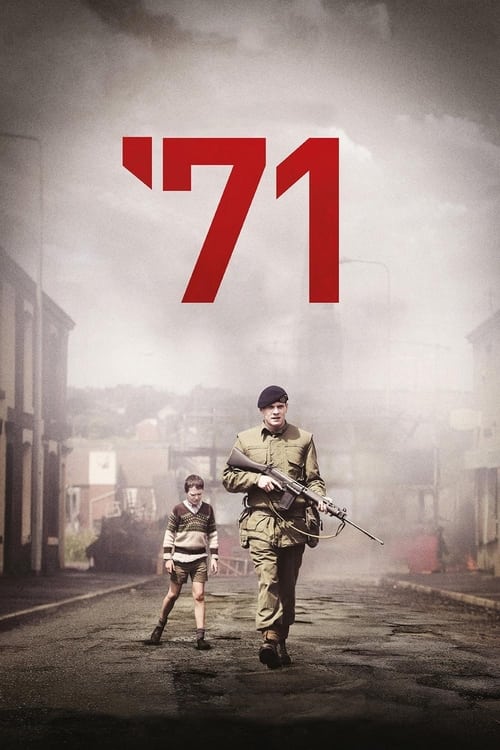
In the movie '71, the ending sees Gary Hook, a British soldier, narrowly escaping the chaos of Belfast during the Troubles. After a harrowing night filled with violence and betrayal, he finds himself alone and hunted. He ultimately manages to evade his pursuers and is rescued by a group of British soldiers, but the experience leaves him deeply scarred and changed.
As the film approaches its climax, the tension escalates. Gary Hook, portrayed by Jack O'Connell, is separated from his unit during a riot in Belfast. The streets are filled with chaos as loyalists and republicans clash, and Gary, a young soldier on his first tour, is thrust into a world of violence and fear.
Scene by scene, the narrative unfolds:
The night begins with Gary and his fellow soldiers patrolling the streets of a divided Belfast. The atmosphere is thick with tension as they encounter hostility from the local population. The soldiers are met with jeers and threats, and the palpable fear of the unknown looms over them. Gary, still naive and idealistic, struggles to comprehend the depth of the conflict surrounding him.
As the patrol continues, a riot erupts, and in the chaos, Gary is separated from his unit. He finds himself alone in a hostile environment, where the lines between friend and foe blur. The streets are dark, and the sounds of violence echo around him. He runs, heart pounding, desperate to find safety.
In a series of frantic encounters, Gary is pursued by both the local paramilitaries and his own comrades, who are unaware of his plight. He witnesses the brutality of the conflict firsthand, as innocent bystanders are caught in the crossfire. The emotional weight of these moments begins to take a toll on him, as he grapples with the reality of war and its impact on civilians.
As the night progresses, Gary seeks refuge in a rundown apartment building, where he meets a young boy named "The Boy" who becomes a symbol of innocence amidst the chaos. The boy, initially frightened, shows Gary a glimmer of humanity in a world filled with violence. Their brief connection highlights the stark contrast between the innocence of youth and the harsh realities of the adult world embroiled in conflict.
However, the safety is short-lived. Gary is discovered by a group of armed men who are part of the local paramilitary. They interrogate him, and the tension escalates as they realize he is a British soldier. The fear in Gary's eyes reflects his understanding of the dire situation he is in. He is not just a soldier; he is a target, a symbol of the oppression felt by the local community.
In a desperate bid for survival, Gary manages to escape from his captors, but not without witnessing the brutal execution of a man who tried to help him. This moment is pivotal, as it solidifies the harsh reality of the conflict and the lengths to which individuals will go to survive. Gary's internal struggle deepens as he grapples with the morality of his situation.
As dawn breaks, Gary finally encounters a group of British soldiers who are searching for him. The relief is palpable, but it is overshadowed by the trauma he has experienced. The soldiers, unaware of the horrors Gary has faced, treat him as a hero returning from the brink. Yet, for Gary, the experience has irrevocably changed him. The innocence he once had is shattered, replaced by a profound understanding of the complexities of war.
The film concludes with Gary being airlifted away from the chaos of Belfast, but the look in his eyes tells a different story. He is a soldier who has survived, but at what cost? The emotional scars of the night linger, and as he looks back at the city, it is clear that he will never be the same again.
In the end, Gary Hook's fate is one of survival, but it is marked by loss and trauma. The film leaves the audience with a haunting reminder of the personal toll of conflict, emphasizing that the scars of war extend far beyond the battlefield. The other characters, such as the boy and the paramilitary members, serve as reflections of the broader societal impact of the Troubles, illustrating the cycle of violence that ensnares everyone involved.
Is there a post-credit scene?
The movie titled '71, produced in 2014, does not have a post-credit scene. The film concludes its narrative without any additional scenes after the credits roll. The story focuses on a young British soldier, Gary Hook, who becomes separated from his unit during a riot in Belfast in 1971. The tension and emotional weight of the film are encapsulated in its main storyline, leaving no room for a post-credit sequence. The film ends on a note that emphasizes the chaos and uncertainty of the time, reflecting the soldier's harrowing experience rather than providing any additional closure or scenes.
What motivates Gary Hook to join the British Army?
Gary Hook, a young soldier, is motivated by a sense of duty and the desire to serve his country. He is portrayed as somewhat naive and idealistic, eager to prove himself and escape his mundane life.
How does Gary Hook end up separated from his unit?
During a riot in Belfast, Gary Hook is separated from his unit when he is tasked with escorting a group of soldiers. The chaos of the situation leads to confusion, and he finds himself alone and lost in hostile territory.
What challenges does Gary face while trying to survive in Belfast?
Gary faces numerous challenges, including being hunted by both the IRA and the British forces. He navigates through the dangerous streets, encounters hostile civilians, and struggles with his own fear and desperation as he tries to find a way back to safety.
How does the character of Sergeant Major McCready influence the story?
Sergeant Major McCready represents the harsh realities of military life and the consequences of the conflict. His character is driven by a desire to maintain order and protect his men, but he also embodies the moral complexities of the situation, often clashing with the younger soldiers' ideals.
What role does the setting of Belfast play in the film?
The setting of Belfast is crucial to the film, as it serves as a backdrop for the intense conflict and chaos of the Troubles. The urban landscape, filled with narrow streets and divided communities, heightens the tension and danger that Gary faces, reflecting the broader societal divisions and violence of the time.
Is this family friendly?
The movie '71, produced in 2014, is not considered family-friendly due to its intense and violent themes. It is set against the backdrop of the Troubles in Northern Ireland and contains several potentially objectionable scenes.
-
Violence and Conflict: The film features graphic depictions of street violence, including riots and armed confrontations, which may be distressing for children or sensitive viewers.
-
Death and Injury: There are scenes that show injuries and fatalities, which can be quite graphic and emotionally impactful.
-
Tension and Fear: The protagonist experiences extreme fear and anxiety throughout the film, which may be unsettling for younger audiences.
-
Themes of War and Betrayal: The narrative explores heavy themes such as betrayal, survival, and the chaos of war, which may be difficult for children to understand or process.
Overall, the film's mature content and intense emotional experiences make it more suitable for adult audiences.







